Let's be honest about why you're here. You want more money.
Maybe you want a few hundred extra a month on the side — money that shows up without picking up more shifts. Or maybe you want a lot more than that. Enough to quit your job and do this instead. Both work. This is one of the simplest ways to get there, and I'm going to show you the whole thing.
Here's the one fact it all sits on: almost every local business needs a website. Most don't have one, or the one they have is bad. And none of them want to build it themselves. That's a gap. You fill the gap. They pay you. That's the business.
It's not a trick or a fad. This gap has been open for years, and it is not closing. Below is exactly how you step into it — starting with the three lies in your head that keep you stuck.
And don't take the size of it on faith — the numbers are enormous:
- There are 33 million+ small businesses in the U.S. (SBA), and 5 million+ new business applications get filed every single year — about 430,000 a month (U.S. Census Bureau). The pool doesn't just sit there; it refills constantly. And that's before you count the rest of the English-speaking world — the U.K., Canada, Australia, New Zealand, Ireland — where the exact same gap is wide open and you can sell to any of them from your laptop.
- Roughly 1 in 4 small businesses still has no website at all. Most of the rest are running one that was built years ago and looks broken on a phone.
- 75% of people judge a business by its website (Stanford). A dated site quietly costs the owner customers every day — which is exactly the problem you get paid to fix.
Millions of new businesses a year, most with no site or an outdated one, and nowhere near enough people building them. There's far more demand than the market can serve. That's your opening.
Here's what you'll learn, in order:
- Why the three reasons you think you can't do this are wrong.
- What to charge, and how the monthly turns into real money.
- How to pick who you help, and where.
- How to build a full website in one afternoon.
- How to find people and message them without freezing up.
- How to get paid — and keep getting paid.
None of this is theory. Read it like you're about to use it, because you can.
The three lies keeping you stuck
Before the "how," let's kill the "why not." You've got three voices in your head. Until they're quiet, nothing here will move you.
Lie 1 — "I'm not techy enough." You don't need to be. This used to be true. Ten years ago, building a site meant code, servers, and hours of fixing bugs on phones. Hard stuff. That's why the local web guy still charges $3,000 and takes three weeks. But that work is done for you now. You type what the business is, and a full site comes out. If you can send a text, you can do this. The skill was never coding. It was just starting.
Lie 2 — "I can't sell. Reaching out scares me." Two things. First, you're not selling some huge thing to a stranger. You're telling an owner their site looks broken on a phone, and that you'll fix it for a fraction of what that guy charges. That's a favor with a price tag. Second, you don't have to think up what to say. The messages are written for you — the first one, and the replies to whatever they say back. People freeze because of the blank screen. There's no blank screen here. You just send messages off a list.
Lie 3 — "Isn't it too late? Everyone does this." No. Here's the part almost nobody gets. Building websites got easy, so lots of people build them. But that's not the job. The job is finding an owner, saying the right thing, getting paid every month, and keeping them happy so they stay. That part was never easy, and most people quit at the first "no." The crowd is all standing at the easy end. The money is at the other end, and it's wide open.
Read those three again. They're not facts. They're just beliefs. Nothing outside you is stopping you. The day you decide they're dead is the day you start.
Why right now is the best time for this
Every one of those lies used to be true. That's the change most people haven't noticed.
The hard part — code, servers, domains, making it work on a phone — is basically gone. The computer writes the words. Templates handle the design. Putting a site online is one click.
Here's the trap people fall into: "if it's easy now, everyone will do it, so there's no money left." Wrong. The building got easy. The business — finding the client, knowing what to say, getting paid every month — is exactly as hard as it always was. That's where the money still is. And almost nobody has a system for that part.
So the goal was never "learn to build websites." Anyone can do that now. The goal is to own the whole machine — find, build, publish, get paid, keep them happy — while everyone else plays with one template and wonders why their phone never rings.
The building is the cheap part now. The business around it is the real thing. Get that, and you don't have a side hobby. You have an agency.
What this business actually is
Here's the whole thing, and it fits in two lines:
- You charge a local business a one-time fee to build and launch their website.
- Then a small monthly to keep it live, updated, and showing up on Google.
That's it. Now look at the second line, because that's the one that changes your life.
The monthly is small on purpose. Small enough that an owner says yes on the spot without checking with anyone. Small enough that it never climbs high enough on their bill to be worth cancelling. That's the whole design. One of them, on its own, is not going to change anything about your week.
Ten of them will. Forty of them is a different life entirely — sites you finished months ago, still paying you for work you already did.
Nobody's promising you forty. That depends on how many people you talk to. But look at the shape of it: you get paid once to build, then paid every month just for the site to exist.
Picture it. It's the 1st of the month. You haven't opened your laptop. The money shows up anyway. That's not a get-rich-quick dream. That's just how monthly income works. It's the difference between "I made some money once" and "I own something that pays me every month."
Here's the part that stings: this only starts the day you start. Every month you "think about it" is a month of that income you never get back. The client you could have signed this month is paying someone else next month — or nobody.

So what are the actual numbers — what to ask for to build it, what to ask for every month, and how to say both out loud without flinching? They're written into the system and the word-for-word scripts that come with it, so you never have to guess what you're worth. Let's walk through the rest piece by piece first.
Step 1: Pick who you help, and where
The biggest beginner mistake is trying to help "anyone." A website for anyone is a website for no one. "I build websites for plumbers in Tampa" beats "I build websites" every time — you sound like the expert, and you already know their world.
So you're choosing two things: a type of business, and a place.
For the type, go after local service businesses that make good money from a single job — plumbers, HVAC, roofers, electricians, landscapers, auto shops, salons, med spas, dentists, contractors. Pick one you know even a little; it makes reaching out less awkward.
For the place, pick something small enough to own — your city, or a few towns near you. Not "the whole country." A big fish in a small pond gets the calls.
That's your whole positioning: "I build websites for [type] in [town]." Simple, specific, and it's exactly why someone replies. Vague gets ignored.
Step 2: Say it in one line
Now you know who you help. Next is what you say — and every message points back to one simple line. It's built from four pieces:
- The problem — what's wrong now. "You don't show up when someone Googles your own name." "Your site looks broken on a phone." "You miss after-hours calls with no way to book."
- The fix — what you give them. "A fast, modern site built to show up on Google, plus a booking page that grabs the job when you can't answer."
- The cost of doing nothing — "Every week, the calls you miss go to the competitor whose site works."
- The win — "You show up when people search you, the phone rings from the site, and it keeps working on its own."
Put it together and you get one clean line: "I help [type] in [town] get [win] without [problem] — a flat fee to build it, a small monthly to keep it running."
That line, plus a couple of example sites, is most of your pitch. And the system builds those example sites for you in minutes — so you can start even with no past work to show.
What if you didn't have to build the machine yourself?
The site builder, the client list, the word-for-word scripts, and your own Stripe — the whole system, already built and ready to run. A one-time $199.
Show me the whole system →One-time $199 · yours forever · no monthly fee · 7-day money-back · keep 100% of what clients pay you
Step 3: Build the site (in an afternoon)
This is where the old hard part used to stop people. Not anymore.
You don't stare at a blank screen. You type what the business is — "barber shop, Fade Co, Tampa" — and a full site comes out: the top banner, services, about, reviews, contact, all of it. The words fit that trade. The photos and colors fit too. A barber and a plumber come out looking totally different, because it's built for the trade, not stamped from one template.
The right temperature, every day of the year.
Same-day AC & heat repair, honest flat-rate pricing, and installs that actually lower your bills. Licensed, insured, local.
Cooling
Heating
Neighbors trust Summit Comfort
“AC died in a heat wave — cool again by that afternoon.”
— Marcus T.
“Fair price, no upsell. Explained everything.”
— Priya S.
“New furnace in a day. House is cozy again.”
— Dan & Rose
Then you just tweak. Everything is click-to-edit. Wrong headline? Click it, retype it. Paste in their real Google reviews. Drop in their logo and it grabs their colors. Add a few photos from your phone.
What used to take a weekend now takes an afternoon. That's the trick: you can build the site the same day you talk to the owner — while they still care — instead of a week later when they've forgotten. When it's ready, you publish with one click. The site goes live on the client's own account, with their own login. Clean handoff, no strings.
Speed wins. Send the preview the same day and you get the client. Send it next week and you're up against whoever they talked to in between.
What makes a site actually get calls
A pretty site isn't the goal. A site that turns visitors into phone calls is. The template already does this — but it helps to know why, so you can point it out when you sell.
- A tap-to-call button, always in reach. On a phone, calling should be one tap. Old sites bury the number; this one keeps it front and center.
- An easy way to book. People decide at 9 p.m. A booking button that grabs the job while the owner sleeps beats "call us during business hours."
- Real reviews near the top. Five-star words from real customers do the selling for you. The site pulls them in.
- It loads fast. If a page takes more than a few seconds, people leave. Fast pages keep them.
- It works on phones. Most local searches happen on a phone. A site that breaks on mobile is invisible.
- It shows up on Google. Built in from day one, so people can actually find it.
You don't build any of this by hand — it comes standard. Your job is knowing it's there, because "your phone will ring more" is what the owner is really buying.
Step 4: Find people and message them
This is the real job — the part a website builder will never do for you.
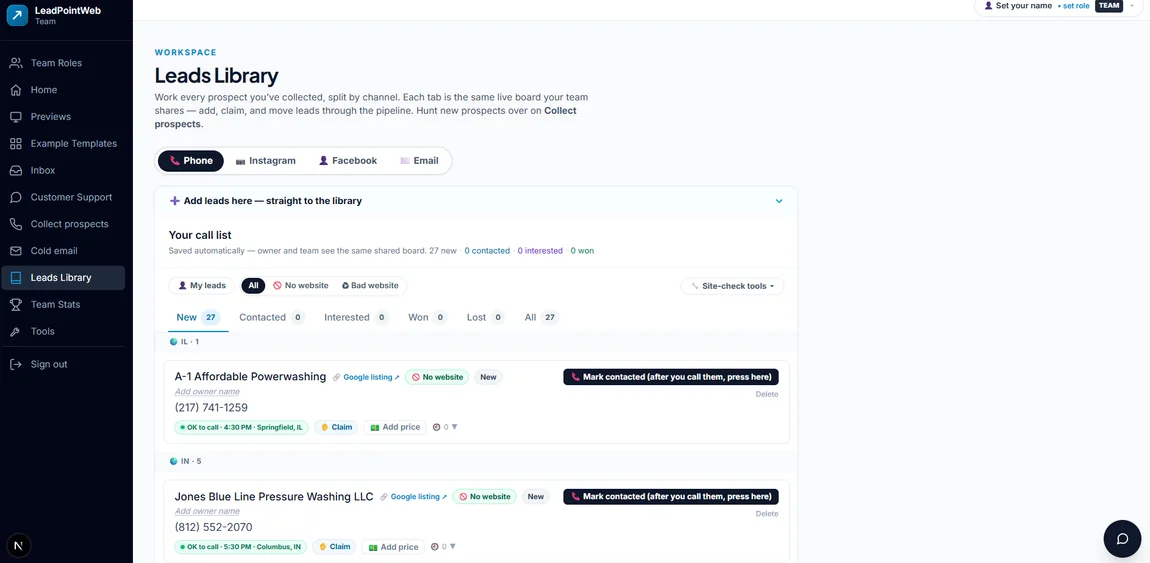
Find them. Collect local businesses that need a site — no site, or an old one — into one list. Sort them by how you'll reach them: call, text, Instagram, email. You're not guessing who to contact. You're working a list.
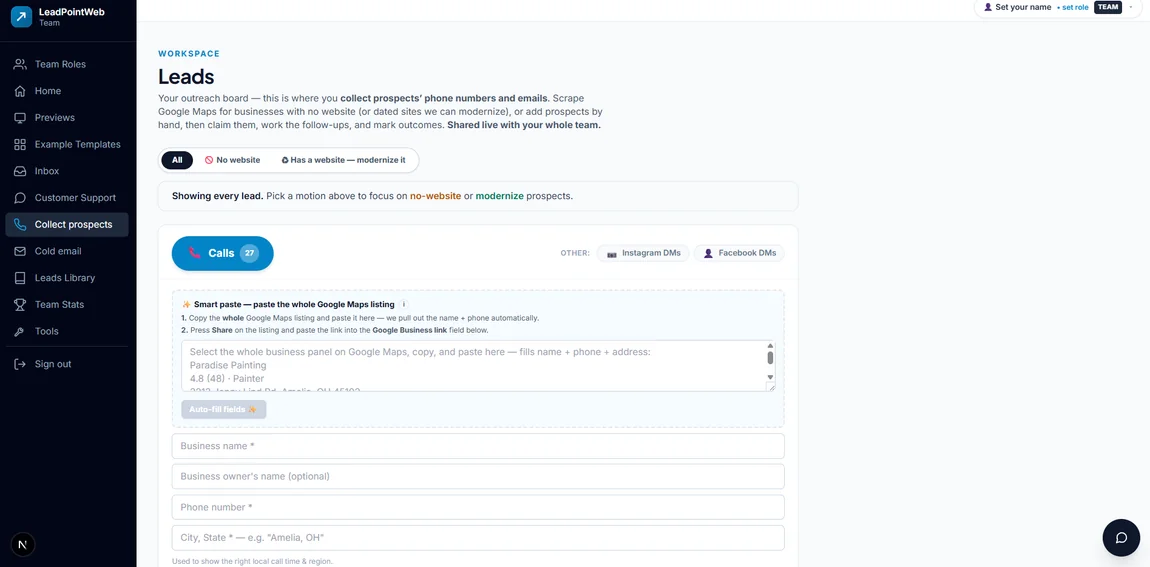
Message them. You won't freeze, because the words are written for you — the first message, and the replies to the three things they'll say back:
- "How much?" — that's interest, not a no. Give the win, then the price: a full site built for them, plus hosting to keep it live — a flat setup fee and a small monthly. Then ask for a quick call.
- "I already have a website." — good, that's your opening. Pull it up and point out one real problem: not mobile-friendly, no way to book, doesn't show up when you search their name. It's a gap they can feel.
- "Just send me info." — don't send a brochure. Send one example link and one next step: a 15-minute call to show them what theirs could look like.
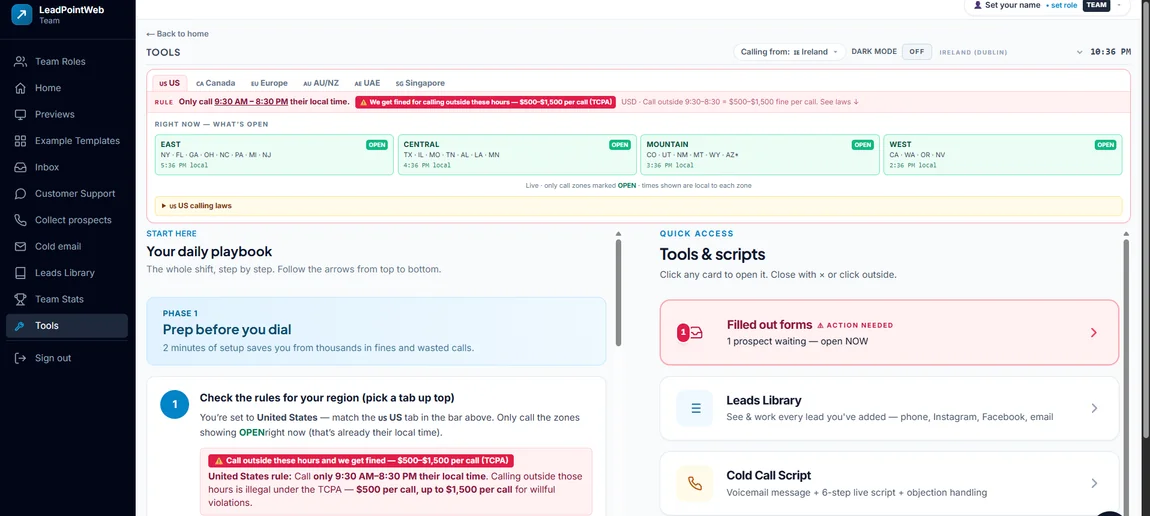
Don't lose them. Every reply moves the person one step forward on your list, with the next follow-up already set. The money is almost never in the first message. It's in the fifth. The list remembers for you.
Close them. When they say yes, the preview is already built. You publish it. Done. You never fumble the moment after "yes," because the site is already sitting there.
The 15-minute call that closes it
When someone says "sure, let's talk," don't overthink it. The call is short and simple.
- Listen first. Ask what bugs them about their current site, or why they never got one. Let them talk — you'll hear the exact problem to solve.
- Show the preview. You already built it. Share your screen or send the link. Watching their own business look great is what sells — not your words.
- Say the price plainly. No stalling, no apologizing. State it like it's the most normal thing in the world, because it is.
- Ask for the yes. "Want me to make it live?" Then stop talking and let them answer.
That's it. You're not "closing" anyone — you showed them something better than what they've got and told them how to get it. Most of the pressure people feel on calls comes from winging it, and you're not winging it — the whole flow is built for you.
Step 5: Get paid (and keep getting paid)
Likes don't pay bills. Nice comments about your design don't pay bills. Getting paid does.
You connect your own Stripe (a trusted way to take card payments), so the money lands straight in your bank. No middleman, no cut taken out — you keep all of it. One clean checkout covers the upfront build and the monthly, so you're never chasing an invoice.
Here's the part that matters: you charge once to build it, then a little every month to keep it running. The one-time fee is easy for a client to haggle over. The monthly isn't — because they're not paying for a webpage, they're paying for a service that keeps them showing up on Google and books their jobs while they sleep. That's worth holding onto.
A plain website is easy to cancel. A website that keeps the phone ringing is not. That's the whole point of the monthly.
Start on the side. Grow it as big as you want.
Here's how the money grows — and why it fits whatever you're after.
Want side money? Do this after work. One or two clients is money landing every month on top of your paycheck, for sites that mostly run themselves. That's the low-risk way in.
Want it to be your main income? Keep stacking clients. Each build takes an afternoon, so you start the next one while the last site runs on its own. A normal job pays you once for each hour, and stops the second you clock out. This pays you to build once, then keeps paying while you sleep, eat, and sign the next one. Twenty sites you built months ago quietly paying for the twenty-first — that's not a hustle, that's a machine.
Make them stay. Every site can carry a real booking page — live times, instant confirm, reminder emails. A business that got two extra jobs last month from a page it didn't even have to answer is not shopping for a cheaper website. That's what keeps the monthly coming.
Let them help themselves. Each site comes with a simple, password-protected editor. When the owner wants to change his hours, he does it himself — instead of texting you at 9 p.m. Your monthly stays profit, not free tech support.
Own the whole tool. Here's the big one: the whole system — builder, client list, launch tools, scripts — is a one-time buy that you own. No monthly fee to us eating your cut. Buy it once, and every dollar your clients pay you is yours.
The secret to scaling: stop renting your software
Here's the mistake that quietly caps most people before they ever get big — and almost nobody warns them about it.
Most "agency in a box" tools are subscriptions. You pay every month, forever, just to keep the lights on. One all-in-one platform runs around $97 a month. Add a separate CRM, a page builder, and a design tool on top, and you're easily $150 to $300 a month — gone every single month, before you've earned a dollar.
Now hold that against the math you just saw. You charge each client a small monthly. If $150 of your income walks straight back out the door to software you're renting, your first three clients aren't paying you — they're paying your tools. You're running flat out just to stand still.
And it gets worse as you grow, not better. Those subscriptions scale up with you: more clients push you to a higher tier, more teammates cost more seats. The bigger you get, the bigger the bite. That's backwards from how a business is supposed to work.
Owning your software flips the whole thing. You buy LeadPoint once and own it. You host it on your own accounts, with no monthly license fee to us, no per-client charge, and no per-seat tax when you add your team. Your cost to own the tools doesn't climb as you grow — client 2, client 20, and client 200 all cost you the same: nothing more than you already paid.
That's the real secret to scaling. It was never about working twice as hard — it's about keeping what you earn. An agency that pays nothing every month for its tools keeps every dollar of every retainer. An agency renting five different tools hands a slice of every client back before it ever sees a profit, then wonders why more clients never quite turns into more money.
Every subscription you cancel is margin you keep forever. The people who scale aren't the ones earning the most — they're the ones leaking the least.
So before you sign up for one more monthly tool, ask one question: what does this bill look like when I have forty clients? Rented software balloons. Software you own is already paid for. Own the whole machine once, and every retainer after that is yours to keep.
Your first 7 days
You don't need a month to get going. Here's a simple week.
- Day 1 — Pick your lane. Choose your one type of business and your town. Write your one-line pitch.
- Day 2 — Build proof. Make one or two example sites so you have something to show. This is where most people stall; you won't, because it takes an afternoon.
- Day 3 — Build your list. Collect local businesses with no site or a bad one. Aim for 30–50 names.
- Days 4–5 — Reach out. Send the first messages off your list, using the scripts. Don't perfect it. Send.
- Day 6 — Follow up. Reply to anyone who answered. Book a quick call or send a preview.
- Day 7 — Close one. Get on a call, show the preview, ask for the yes. Even a no teaches you the whole loop — and the next one is easier.
One week to your first real conversation. Slower is fine too. The only version that fails is the one you never start.
Straight answers to what you're still wondering
"What if they say no?" Most will at first. That's normal — it's a numbers game, not a talent test. Every no gets you closer to a yes, and the scripts handle the common ones for you.
"Do I need experience?" No. You're not coding or designing from scratch. If you can describe a business and send a message, you have enough to start.
"Isn't this saturated?" The building got crowded. The doing — reaching out, following up, closing — never did, because most people quit early. Do the boring part and the crowd disappears.
"What if I can't build a good site?" You don't build it, really. You describe the business and tweak what comes out. It looks professional because the template is professional.
"How fast can I make money?" That's up to how many people you talk to — no one can promise a timeline. But one client can pay back the whole thing, and everything after that is yours.
So just start
Here's the honest truth: you already understand the business. It's not complicated. Pick a type and a town. Write your one line. Build a couple of example sites. Message people with the scripts. Publish when they say yes. Charge your setup fee and the monthly. Do it again.
The only thing left is the gap between knowing it and doing it. That gap is where almost everyone loses — not to smarter people, not to being "not ready," but to saying "I'll start next month," every month, forever.
Go back to the three lies at the top. They're gone. You watched them fall apart. So the only thing that can stop you now is you, choosing to wait again.
And you don't even have to build the machine yourself — it already exists as one download you own: the builder that turns a sentence into a site, the tools that get it found, the client list and word-for-word scripts, and your own Stripe so every dollar is yours. Buy it once. Keep everything your clients ever pay you.
You've got the plan now. The only thing between you and your first paying client is starting.
You just read the whole thing instead of scrolling past it. That's the exact thing that separates the people who own agencies from the people who only talk about it. You're already the type. Your first client is one message away. Go send it.